November 14, 2025, CUFE Business School held the 5th session of the 1st phase of the 2025 Doctoral Research Capacity Enhancement Program in Conference Room 602. Associate Professor Liu Boluo from the School of Accountancy at Shanghai University of Finance and Economics was invited as the keynote speaker. He shared his insights and techniques on writing English academic papers in the fields of finance and accounting, as well as the lessons learned from his research experience including three core aspects: data processing, writing expression, and contribution extraction. More than 20 participants from CUFE Business School attended the session. The event was prepared and organized by Associate Professor Dou Chao, Director of the CUFE Business School PhD Program. The Doctoral Research Capacity Enhancement Program is a distinctive initiative launched by CUFE Business School to improve doctoral students’ research capabilities. The program adopts a “lecture + mentoring” format and covers the entire core process of academic research. It is organized once each academic year, with each phase consisting of several sessions that span multiple disciplinary directions, including research topic selection, literature review, research design, methodological techniques, academic writing, and manuscript submission and revision.

The session was chaired by Associate Professor Dou Chao, Director of the CUFE Business School PhD Program. At the beginning of the session, Associate Professor Dou briefly introduced the keynote speaker, Associate Professor Liu Boluo. Associate Professor Liu received his bachelor’s degree from Wuhan University and his PhD from City University of Hong Kong. He currently serves as Associate Professor at the School of Accountancy, Shanghai University of Finance and Economics, with primary research interests in information disclosure.
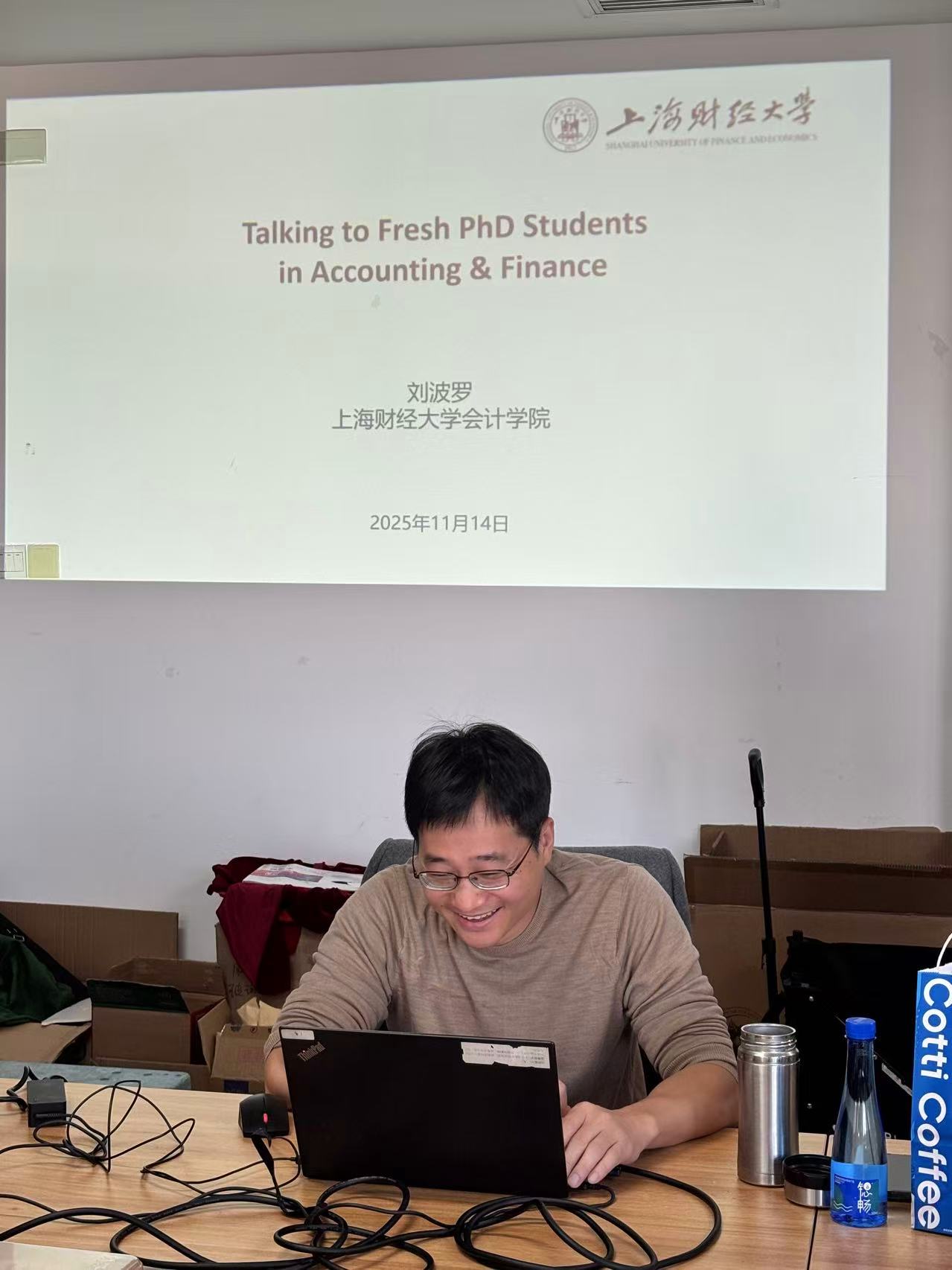
Associate Professor Liu Boluo
Associate Professor Liu shared his experience across three core stages: data processing, writing expression, and research topic development. He emphasized that empirical analysis is the cornerstone of academic research and must strictly adhere to academic norms. He suggested that researchers flexibly combine the strengths of tools such as SAS and Stata to achieve more efficient and reliable data analysis. Regarding academic writing, he noted that the most important step is to thoroughly clarify the internal logic before beginning to write. Academic papers can follow a rigorous structural logic similar to the classical “eight-legged essay,” while literature reviews should not only summarize studies related to the core variables but also identify research gaps on that basis. In terms of generating research ideas, Professor Liu suggested that scholars should deeply engage with both classical and frontier literature and systematically organize relevant variables, measurement approaches, and theoretical frameworks. Breakthroughs in innovation often originate from new theories, new phenomena, or new data. At the end of the session, Professor Liu concluded with the remark, “Ideas are cheap. Execution is expensive,” encouraging students to transform ideas into solid academic achievements through active collaboration and persistent effort. The session provided practical and actionable guidance for doctoral students’ research work.
This session offered doctoral students present a research-oriented inspiration that combined intellectual depth with practical relevance. Professor Liu’s valuable insights—from rigorous data processing to clear writing logic and innovative research topic development—helped students navigate key stages of academic production. His sharing not only focused on research methodologies themselves but also conveyed a pragmatic and profound academic value system: genuine academic growth stems from the careful evaluation of every variable, the repeated scrutiny of every line of logic, and the persistent execution of every idea.