December 6 to 7, 2025, the 6th National Conference on Supply Chain and Operation Management (ISCOM 2025) was held in Wuxi, Jiangsu Province. With the theme of “Supply Chain Ecosystem Transformation and Management Innovation in the Digital-Intelligent Era,” the conference attracted experts and scholars from numerous universities, research institutions, and industry enterprises across China for academic exchange. A collaborative paper titled “Operational Stress on On-Demand Delivery Platform Management, Consequences, and Scheduling Implications” co-authored by Professor Dai Hongyan of CUFE Business School, Associate Professor Jiao Zihao of Beijing Technology and Business University, graduate student Xie Xianyi, Assistant Professor Xiao Qin of Jiangxi University of Finance and Economics, and Tenured Associate Professor Xu Yuxi of the University of North Carolina at Chapel Hill was awarded the First Prize for Best Conference Paper at ISCOM 2025.

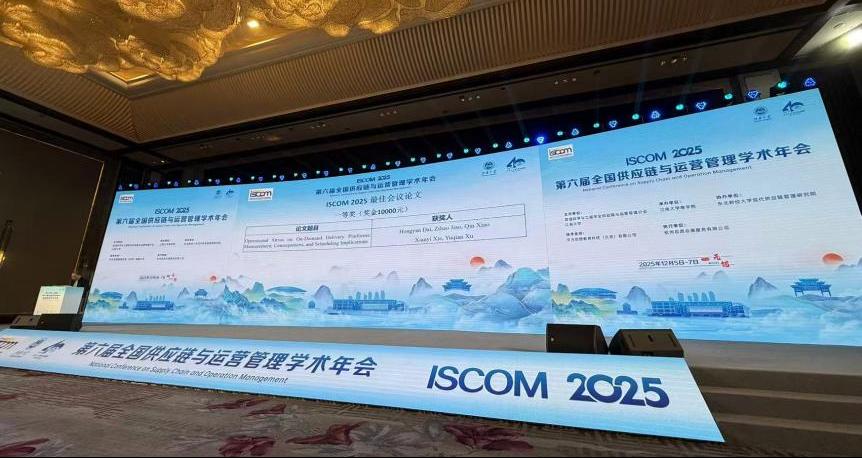
The National Conference on Supply Chain and Operation Management (ISCOM) was initiated and organized by the Supply Chain and Operations Management Branch of the Chinese Society of Management Science and Engineering and has been successfully held five times to date. The Supply Chain and Operations Management Branch is a secondary branch under the Chinese Society of Management Science and Engineering and was established in October 2018. The ISCOM conference focuses on frontier theories and practices in the fields of supply chain and operations management, serving as a platform for academic exchange and collaboration among scholars, industry practitioners, and relevant government departments engaged in supply chain management and operations management research. Each year, the conference selects one First Prize, two Second Prizes, three Third Prizes, and four Honorable Mentions for Best Conference Papers.
The phenomenon of “riders trapped by algorithms” has drawn widespread public attention to on-demand delivery riders. Addressing the prominent issues of riders’ excessive stress, high safety risks, and high workforce turnover in on-demand delivery, this study develops a responsible AI-driven intelligent scheduling model. Centered on the coordinated optimization of “delay-stress,” the model incorporates several key innovations. At the modeling stage, it introduces a rider-level stress indicator that integrates order time urgency, task sequence clustering, and work rhythm into a real-time measurable workload metric. At the decision-making stage, the study embeds a pre-trained random forest into a mixed integer programming through an ML-to-MIP conversion. In addition, a personalized random forest model based on clustering riders by capability and a Top-w-based imbalanced sampling strategy are adopted to effectively reduce model dimensionality and computational complexity under the premise of controlling optimality loss. The proposed model not only significantly reduces overall delay rates and rider stress levels but also improves fairness in stress distribution, providing a practical pathway for exploring humanistic intelligent scheduling.
Professor Dai Hongyan has conducted long-term and in-depth research in areas such as AI-driven optimization and decision-making and human-AI interaction based on large language models. She has achieved substantial research outcomes, publishing more than 40 academic papers in leading journals including Management Science, European Journal of Operational Research, and Journal of Management Sciences in China. She has led multiple national and provincial research projects, including a Cultivation Project of the Major Research Plan of the National Natural Science Foundation of China and General Program of the National Natural Science Foundation of China. She was awarded the First Prize in Scientific and Technological Progress by the China Federation of Logistics & Purchasing, the Second Prize of the "Management Practice Award" by the Chinese Scholars Association for Management Science and Engineering, the Third Prize in Scientific and Technological Progress by Zhejiang Province, and multiple Best Paper Awards (First Prize) at various international conferences. The AI-driven forecasting and scheduling systems developed by her research team have also been implemented in multiple enterprises.