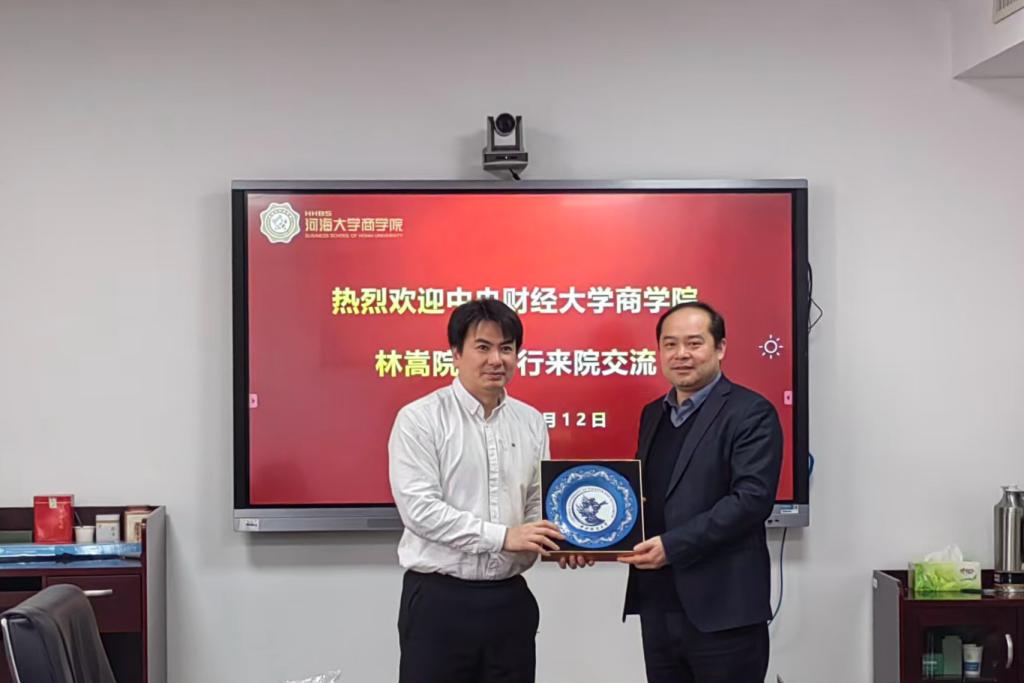
March 12, 2026, Professor Lin Song, Dean of CUFE Business School, together with Associate Professor Dou Chao from the Department of Finance and Financial Management, visited Hohai University to conduct an on-site study of the construction and current status of its science and technology business school. Professor Zhang Changzheng, Dean of the Business School of Hohai University, along with other relevant faculty members, warmly received the delegation. The two sides engaged in in-depth discussions and exchanges on the positioning, development plans, and future trends of science and technology business schools.
At the beginning of the visit, accompanied by Dean Zhang Changzheng, Dean Lin Song and Associate Professor Dou Chao toured the teaching and research facilities of the Business School of Hohai University. During the research visit, representatives of the Business School of Hohai University provided a detailed introduction to their explorations and practices in developing a science and technology business school, with a focus on interdisciplinary integration, the construction of digital teaching facilities, the establishment of industry-academia-research collaboration platforms, and the cultivation of innovative and entrepreneurial talent, as well as the phased achievements made in these areas. Professor Lin Song and Associate Professor Dou Chao listened attentively and, from time to time, inquired about specific details such as curriculum design, faculty allocation, and student practice programs, expressing strong interest in the pioneering efforts of the Business School of Hohai University in this field.
Subsequently, a symposium was held. On behalf of the Business School of Hohai University, Professor Zhang Changzheng extended a warm welcome to colleagues from CUFE Business School and systematically elaborated on the background, strategic positioning, and future development plan of Hohai University’s science and technology business school. He noted that the development of a science and technology business school is an important initiative to respond to the national demand for the development of new quality productive forces and to advance the reform of business education. Hohai University is committed to building a distinctive and internationally renowned business school with “Hohai characteristics,” and hopes to use this exchange as an opportunity to share insights and jointly explore development pathways.
On behalf of CUFE Business School, Professor Lin Song expressed his gratitude for the thoughtful arrangements made by Hohai University. He introduced the traditional strengths of CUFE Business School in discipline development and talent cultivation, and, in light of the current challenges facing finance and economics education, shared his perspectives on the development of science and technology business schools. Professor Lin Song remarked that the explorations of the Business School of Hohai University in empowering business education through science and technology are highly inspiring, particularly its distinctive development path of business disciplines supported by a science and engineering background, which is worthy of in-depth study.
During the open discussion session, both sides engaged in lively exchanges on key issues in the development of science and technology business schools. The discussion focused on how to precisely define disciplinary boundaries, how to construct an integrated curriculum system of “technology + industry + management,” how to attract interdisciplinary faculty through institutional innovation, and how to leverage alumni resources to facilitate the commercialization of technological achievements. Both sides agreed that, in the context of the deep integration of the digital economy and technological innovation, business schools at both universities face similar opportunities and challenges, and that regular communication should be strengthened.
This research and exchange activity not only deepened CUFE Business School’s understanding of the current development of science and technology business schools at peer institutions, but also laid a foundation for future in-depth cooperation between the two sides. Both parties expressed that, taking this visit as an opportunity, they will further establish mechanisms for resource sharing and collaboration, and carry out more practical cooperation in areas such as discipline development, case development, resource sharing, and joint student training. Together, they will explore a China-specific model for building science and technology business schools and cultivate more interdisciplinary finance and economics talents with innovative spirit and practical capabilities to serve the national strategy of building a technological powerhouse and promoting high-quality economic development.